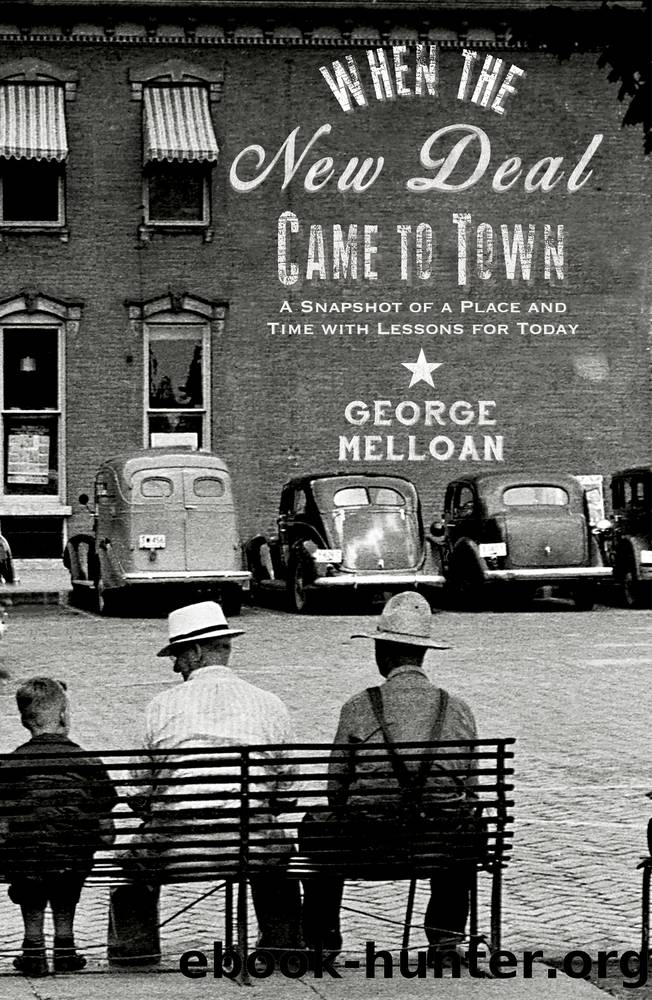
When the New Deal Came to Town by George Melloan
Author:George Melloan
Language: eng
Format: epub
Publisher: Threshold Editions
CHAPTER EIGHTEEN
THE HUCKSTERS
The Sharps
THE SHARPS, LIKE other farmers, had security during hard times not available to nonfarmers. They could live off the land. Whereas an unemployed factory worker in the city might have to seek relief from a soup kitchen, the Salvation Army, or a government agency, the Sharp family could subsist quite comfortably on a small portion of what their farm produced. Carolyn describes how they lived:
âIf it wasnât raised in the garden, we didnât have it to eat. Mother canned fruits and vegetables. A hog was butchered every year, as well as a beef. [Butchering was often a group effort of several farmers, much like the threshing rings.] The pork that was cured, hams, and bacon hung in what we called the smokehouse. The rest of the pork was cooked in some fashion, generally fried, then placed in tin cans. We had a sealer and when finished they looked like commercially prepared cans. Then they were placed in boilers, covered with water, and placed on the coal range, where the water kept boiling. It was hours, not minutes, that they cooked. I never knew any that spoiled. The grease ârenderedâ from cooking meat would harden into lard and would be stored for later cooking use in large five-gallon lard cans.
âMother would cut bacon off the side of pork that had been cured. After a period of time it was possible there would be mold. She cut the mold off and still used the bacon. We often remarked in later years that we got our penicillin early.â (Penicillin, made from a mold, wasnât produced commercially until World War II. Also during World War II, housewives were urged to donate their bacon fat to the government. The glycerin extracted from it was used to make bombs and munitions.)
Garden produce was also preserved, writes Carolyn. âSweet potatoes were dug, wrapped individually in paper, and stored in an upstairs closet that was not heated. Irish potatoes were dug and stored in the cellar. We ate well.â
Carolynâs mother, Marguerite, like mine after we moved to town, would order baby chicks by mail, Iâm not sure from what hatchery but probably one not very distant. One morning every spring you could walk into the Whiteland post office and hear a great deal of cheeping. The chicks had arrived! They came by express trainsâthat made special stops to unload themâin what looked like suit boxes, but divided into four compartments so the chicks wouldnât bunch up and smother each other.
The owners would claim them, bring them home to a chicken wire enclosure, and put them in an incubator, which was a hooded shelter with a heater fueled by coal oil, with trays for water and chicken feed. There they would mature, grow feathers, be turned out into the chicken yard, and eventually become family Sunday dinners or egg producers.
As Carolyn puts it: âAs the chickens grew it became evident which were pullets (female) and which were roosters. The roosters were the ones we ate. In
Download
This site does not store any files on its server. We only index and link to content provided by other sites. Please contact the content providers to delete copyright contents if any and email us, we'll remove relevant links or contents immediately.
| Africa | Americas |
| Arctic & Antarctica | Asia |
| Australia & Oceania | Europe |
| Middle East | Russia |
| United States | World |
| Ancient Civilizations | Military |
| Historical Study & Educational Resources |
The Dawn of Everything by David Graeber & David Wengrow(1763)
The Bomber Mafia by Malcolm Gladwell(1665)
Facing the Mountain by Daniel James Brown(1598)
Submerged Prehistory by Benjamin Jonathan; & Clive Bonsall & Catriona Pickard & Anders Fischer(1494)
Wandering in Strange Lands by Morgan Jerkins(1482)
Tip Top by Bill James(1480)
Driving While Brown: Sheriff Joe Arpaio Versus the Latino Resistance by Terry Greene Sterling & Jude Joffe-Block(1410)
Red Roulette : An Insider's Story of Wealth, Power, Corruption, and Vengeance in Today's China (9781982156176) by Shum Desmond(1395)
Evil Geniuses: The Unmaking of America: A Recent History by Kurt Andersen(1393)
The Way of Fire and Ice: The Living Tradition of Norse Paganism by Ryan Smith(1369)
American Kompromat by Craig Unger(1359)
F*cking History by The Captain(1350)
It Was All a Lie by Stuart Stevens;(1341)
American Dreams by Unknown(1317)
Treasure Islands: Tax Havens and the Men who Stole the World by Nicholas Shaxson(1304)
Evil Geniuses by Kurt Andersen(1296)
White House Inc. by Dan Alexander(1243)
The First Conspiracy by Brad Meltzer & Josh Mensch(1214)
The Fifteen Biggest Lies about the Economy: And Everything Else the Right Doesn't Want You to Know about Taxes, Jobs, and Corporate America by Joshua Holland(1159)
